What's it really like to cross the Channel on wind power?
For our passengers, the journey starts well before the crossing. Usually with some surprise that a sailing ferry across the Channel exists at all, then the excitement of wondering whether you could actually do it. Maybe for your next cycle tour, maybe because you were crossing this year anyway, or simply for a weekend in Boulogne or in Kent.
- RouteDover to Boulogne-sur-Mer, centre town marina to centre town marina, with SailLink, the first scheduled passenger sail ferry across the Channel.
- The boatEchoes, a 17-metre wind powered cross-Channel catamaran.
- PassportsChecked by border police on the pontoon before departure, and again on arrival.
- PassengersTwelve at most, with up to twelve bikes stowed inside the cabin. More in our guide to taking your bike to France.
- Time at seaAround four and a half hours on average. The wind decides.
- Under sailWe motor out of the harbour, then switch off. In 2026 we sailed 74.5% of the distance between the two ports.
- What to bringWarm layers, a windproof jacket, your passport and a charged power bank, as there are no sockets on board. Tea is on us.
Before the day
Then comes the planning, sometimes hectic, and often a bit of persuading of friends or family. Between booking and the day itself, questions come up, ideas, maybe a few worries. That's quite normal. What you're about to do isn't normal yet, at least not your normal. We hope it pushes your sense of adventure, and the edges of your comfort zone, for a few hours. Most of the practical answers are on our website, in the FAQ and in your booking information.
At the meeting point
On the day, a mix of excitement and nerves is to be expected. Sailing is a natural experience, and the weather shapes the whole thing. We ask passengers to be at the meeting point 45 minutes before departure, and that's usually where you find out everyone else feels about the same. For many of them it's their first time sailing too. Talking and joking together settles the nerves and tells you a bit about your team-mates for the journey.
It's also where you get your first look at the boat that will carry you across. We hope Echoes is a reassuring sight.
Down on the pontoon
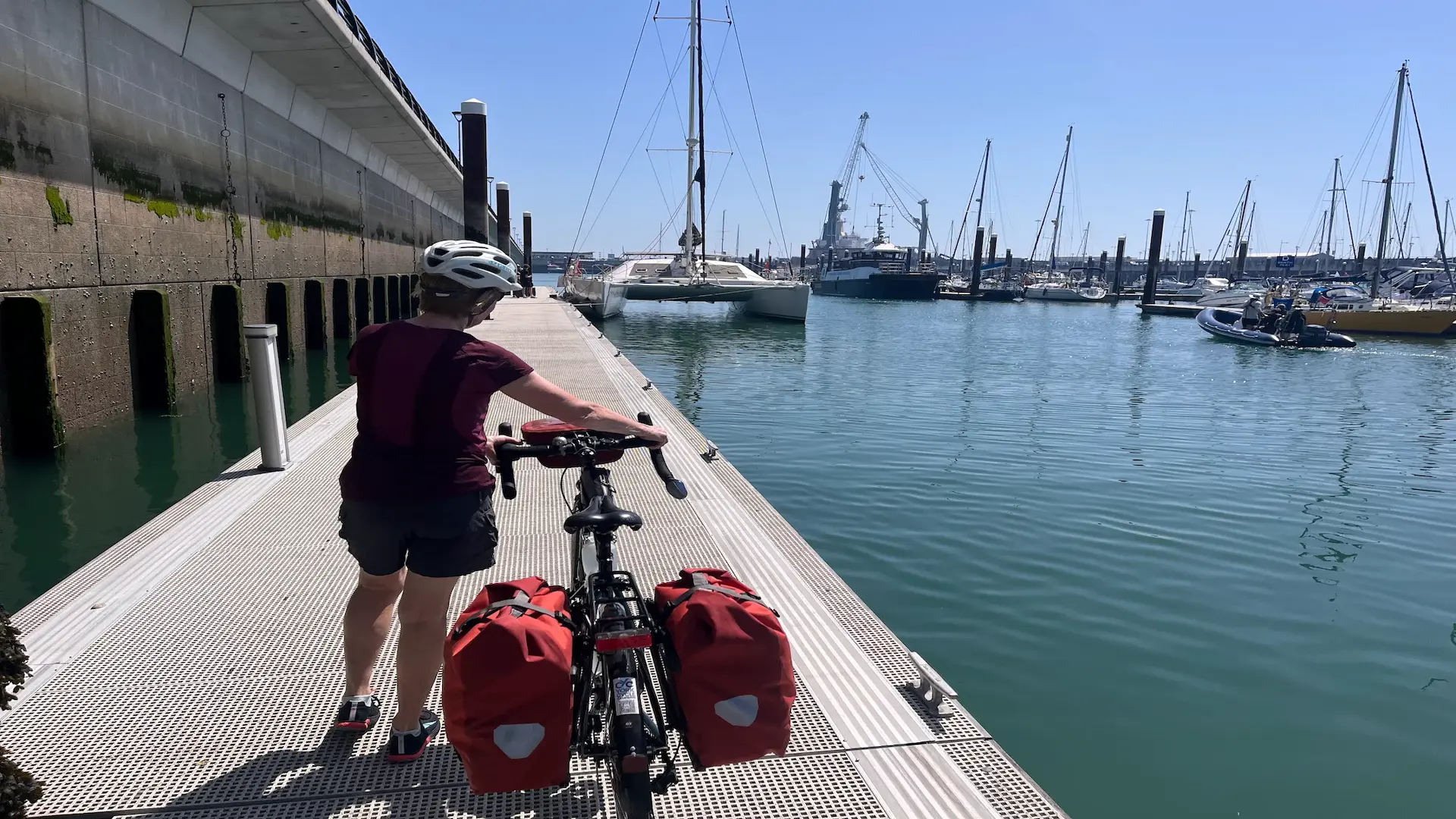
One of the crew comes over, introduces themselves and takes you down to the pontoon, where a welcome is waiting. Bags are passed on board, bikes too. Keep your passport handy: it's checked by border police before we leave, and again when we arrive. The scene has the air of an old dockside in miniature, with luggage being handed across, people watching from the quay, greetings everywhere and a few formalities somewhere in the middle. It's human scale, and there's nothing old-fashioned about it.
Echoes, our sailing catamaran, was built for a family to go cruising, and what we do with her is closer to public transport. With twelve passengers stowing luggage, digging out passports and pulling on extra layers, her spacious saloon suddenly feels very small. This is when everyone finds their bearings. Where is everything? What's down there? Is there a toilet? (Yes.) Can I get to my bag? (Yes.) Who's crew and who's a passenger? Ah, that one's the captain.
Lifejackets, then the briefing
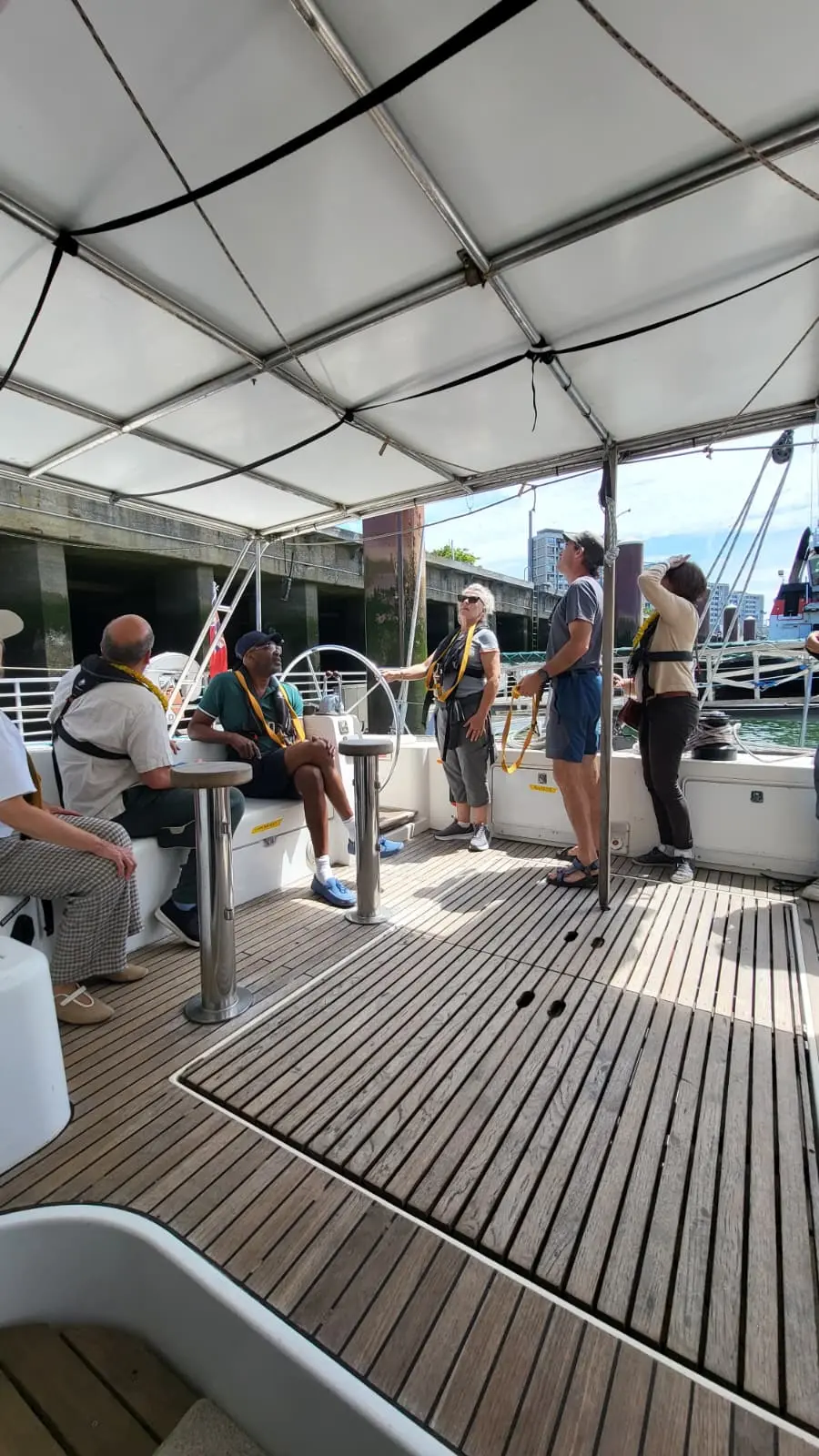
Before we can set off, lifejackets go on, which means dressing for being at sea rather than for the harbour. Your warm clothes need to go under the lifejacket. Then we give a safety briefing: how to move around the boat, what not to do, how we'll get out of the harbour and, of course, when there'll be tea. That's what the 45 minutes are for, and why we're happy when we leave on time. Even then, we're still tied to the pontoon.
Leaving the harbour
Finally the engines start, the lines come off, we radio the harbour and the boat gets under way. We always motor at first, at least until we're in enough open water to raise the sails. Then we see whether we can switch the engines off straight away or still need them for a while. Across the 2026 season we sailed nearly 75% of the distance between the two harbours, on a route with a long history of its own. Having that much usable wind on this stretch of water is what makes sailing across the Channel such an obvious way to travel.
When does it become real sailing?
In maritime law, any boat using an engine is simply a motor vessel. When we can switch off and rely on the wind, we become a sailing vessel. That moment is liberating, and it's special every time.
Engines are noisy, they smell and they pollute, and they also tie us to the land. They're what let us manoeuvre through the harbours and on and off the pontoons. Once they're off, we have to live by natural laws. To make our way across, we set the boat, the sails, our strategy and everything we do according to the wind, the water, the current and the waves. With engines you plough straight through and count down the hours (and the fuel) until you arrive. Sailing is a constant balancing act, and you have to be in tune with everything around you.
The moment we can turn the engines off is the moment we become free of the land.
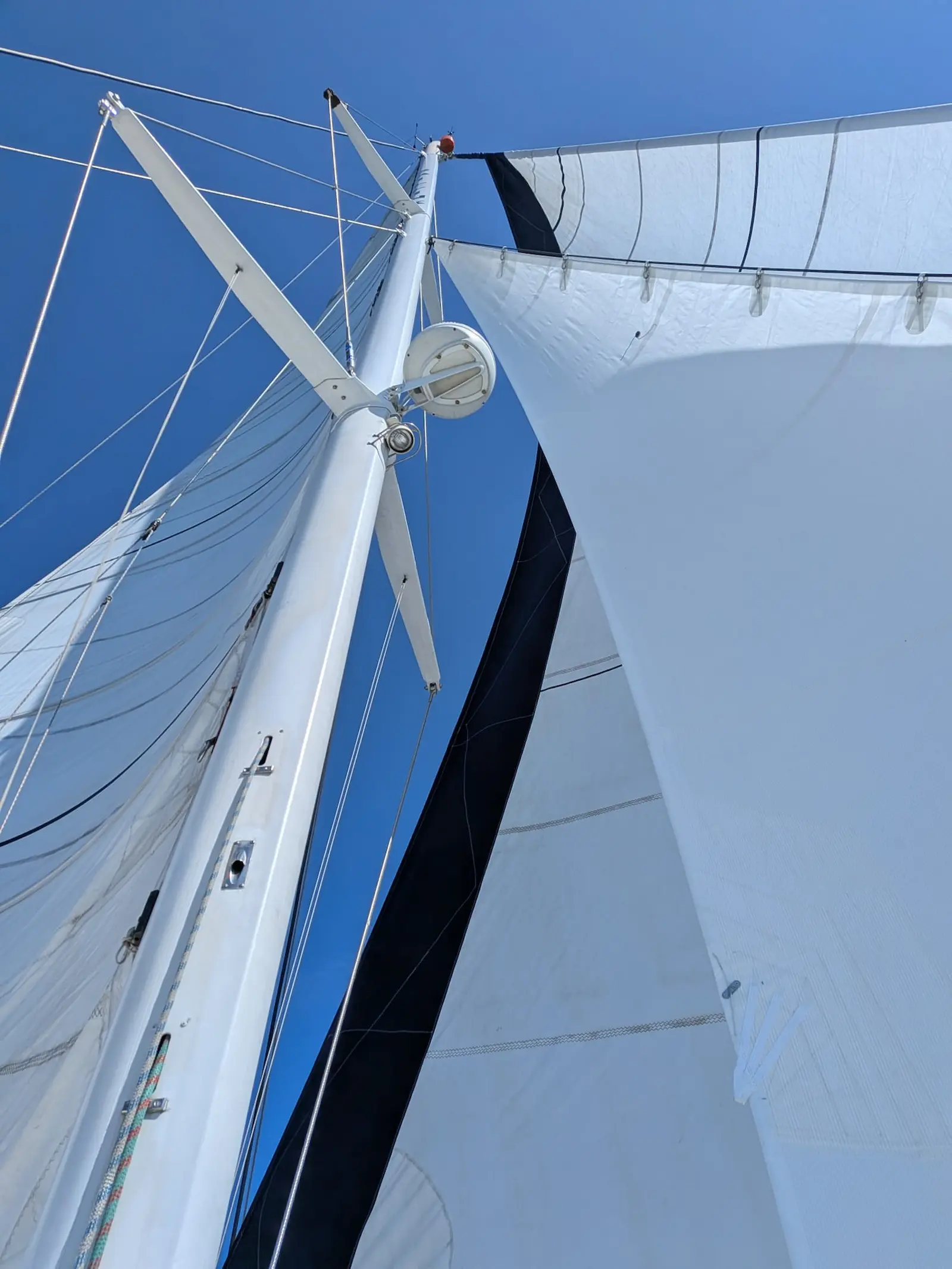
We're the only cross-Channel sailing ferry, so we don't (yet) have anyone to race against, apart from the odd private yacht that happens to leave at the same time. That has happened twice so far, which shows you how rarely the sailing boats in marinas actually get used. So we run our own race: engines off as soon as it's safe, and see how fast we can make the crossing. That's only on days when the conditions are right. Most of the time we're happy sailing at 8 to 10 knots towards the other port, which keeps us well on schedule.
What do you see sailing across the Channel?
I'm busy with the boat for much of the crossing, so some of the best descriptions of what's out there come from passengers, in the reviews and notes they leave afterwards.
Whichever way you go, the other coast takes its time. One passenger leaving Boulogne described watching "the coastline and the white cliffs of Dover gradually appear". Another arrived in Dover at sunset, and on the early sailings out of Dover you set off as the sun comes up. In between there's the Strait itself, with the big freighters working their way through in the distance while you move along at the speed of the wind.
Then there's the wildlife. Several passengers saw dolphins this season, others spotted seals, and one morning, just out of Boulogne harbour, a group crossed paths with a few porpoises. On another crossing, a passenger missed the jellyfish everyone else had spotted. None of it runs to a timetable. As one passenger wrote after a crossing with dolphins: "Obviously dolphins and fair winds can't be guaranteed, but I reckon the coffee is always there."
Above all, there's the sea at eye level. One passenger booked precisely to cross "at sea level rather than ferry level". Once the engines are off, another wrote, all you hear is the sea and the murmur of conversation, with the wind in your face and open water all around. On livelier days the sea comes closer still. A couple who crossed on a choppy day found that staying outside and watching the horizon made all the difference, and that the rougher sea, spray included, actually made the experience for them.
The hardest part
For me, it's the part none of us want: switching the engines back on because there isn't enough wind. It can make the whole thing feel a bit pointless. When the wind is there, though, it can carry us a long way fast: our quickest crossing in 2026 took 2 hours 18 minutes, harbour to harbour.
Twelve strangers at sea
Not everyone gets to know everyone else. It's perfectly fine to come aboard and spend the crossing gazing out to sea without socialising much, and that's a very special way to spend the time. Where else can we spend so long "not doing anything" while doing so much for the soul? It's rare these days. Some people lounge, some chat. It's entirely up to them.
A small boat on a big sea keeps everyone close, though, so there are always plenty of conversations, and I hope a few friendships too. The people you meet on board are one of the natural unknowns of the journey, just like the weather.
What should you wear to cross the Channel by sail?
I wouldn't say first-timers get anything wrong. It's just a lack of experience, and it nearly always comes down to the cold. People don't anticipate how much the temperature drops at sea in the wind. For passengers, a crossing is a lot of sitting around with moments of activity in between, so dress warmly and bring a windproof layer. That way you can stay out on deck, or take a turn at the helm, for a couple of hours.
Stepping off
If they've had a good time, people usually step off exhilarated to have done it. Stepping back onto land must be reassurance, satisfaction and a sense of departure all at once. Border police check passports again on arrival, right there on the pontoon, and people are often surprised at how quickly it's done, without the queues and terminals they're used to. Once that's done, yes, you're free to go. Welcome to Boulogne. Or to Dover.
The best part, every time
Getting a hug from a passenger who has enjoyed it so much that they now feel like a friend. Recognising the face of someone coming back for another trip, and maybe hearing why they're travelling this time. And when a crew member brings me a lovely cup of tea. At sea, that's always a tiny delight.
Is it the thing I was missing?
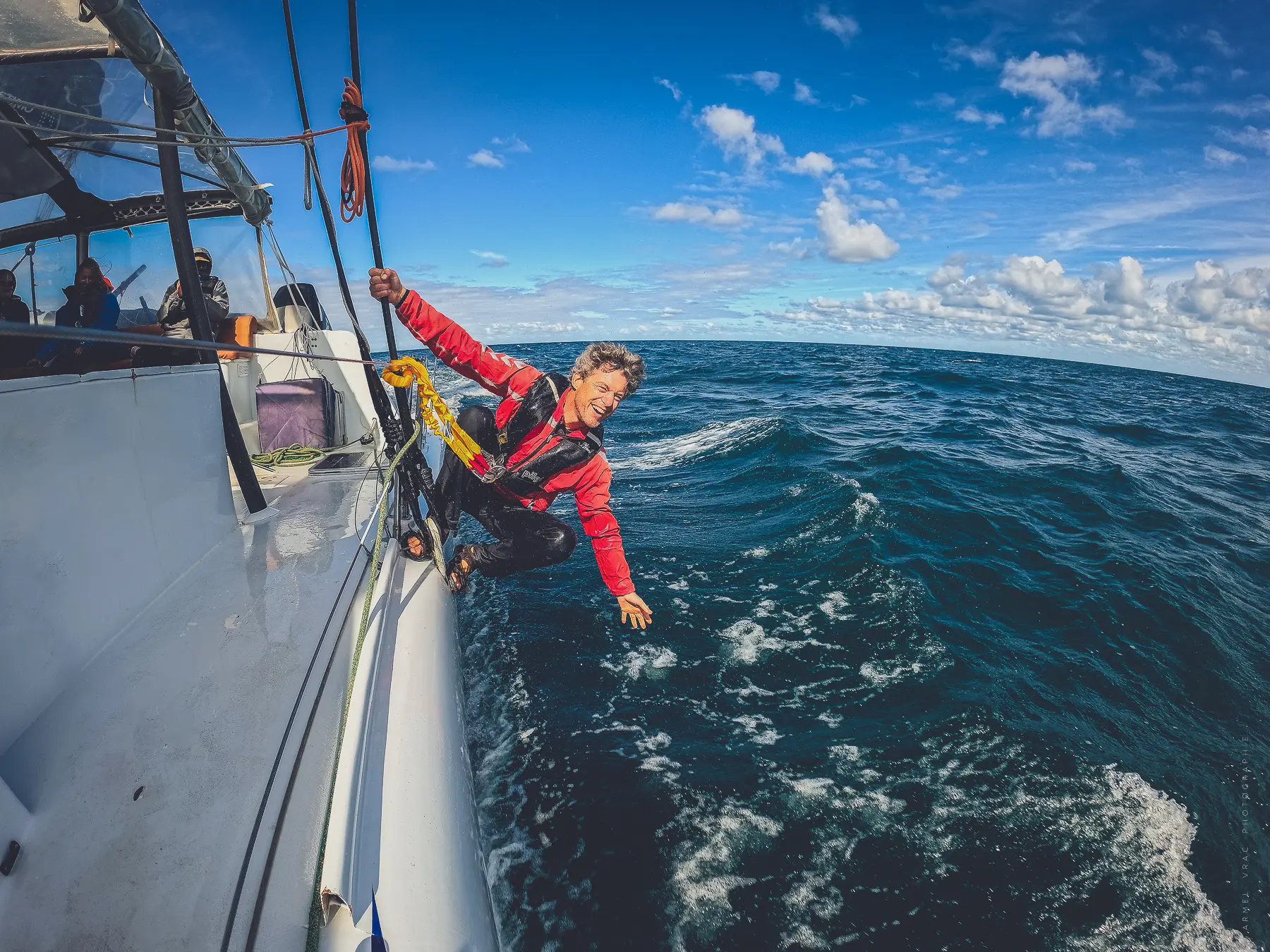
I started SailLink because I couldn't find a natural way across the Channel myself. Out there now, as the captain, I'm usually busy with everything going on, with what might happen next and with the timings. But yes, it does feel like the thing I was missing: a cross-Channel service, mainly powered by nature, running from town to town and designed for foot passengers and cyclists. Making such a genuine experience possible, a chance to connect with the sea, with nature and with other people, is fantastic. Every crossing is different because of it.
What I like most is how much better it can still get. We can make fuller use of the natural forces, develop purpose-built boats, welcome an even wider range of people on board, run the same idea on other routes and inspire others to do something similar.
Ferries and the tunnel serve a clear purpose, and I use them myself when that's what my journey needs, so I'm not here to demonise them. SailLink is a very different way to cross, with other purposes in mind. Our job is to keep it as different as possible while holding on to what it's for: a natural connection.
Cross the Channel on wind power
Foot passengers and cyclists, from one town centre to the other.