How to take your bike to France from the UK, in one piece
Getting yourself across the Channel is easy. Getting your bike to France, loaded and ready to ride on the other side, is where the trip starts to get complicated. Every option works in its own way, and each one asks your bike to become something else for a few hours: a vehicle, a parcel, a passenger on a minibus. We built SailLink so it could stay a bike.
Your options for crossing the Channel with a bike
You can take a bike from the UK to France in four ways: on a ferry from Dover to Calais or Dunkirk, on Eurostar from London to Paris or Brussels, through the Channel Tunnel with LeShuttle's minibus for cyclists, or under sail with SailLink from Dover to Boulogne-sur-Mer. This is how each one works as of October 2026. Operators change their rules from time to time, so check their own pages before you book.
Taking your bike on the ferry from Dover to Calais
The big ferries take bikes, and the crossing itself lasts about an hour and a half. As a cyclist you check in like a vehicle. P&O asks you to arrive 90 minutes before departure, then you follow a red line painted through the port of Dover, wait in the lanes with the cars and lorries, ride onto the car deck and tie your bike to a rail before heading upstairs. DFDS does not sell foot passenger tickets on its Dover to Calais route, so your bike is in effect your ticket. P&O takes one bike per booking, which means a group has to book separately, and bike spaces on popular sailings can sell out. You land in a busy industrial port on the edge of Calais. Plenty of touring cyclists use it every year and it does the job; the regulars on cycling forums advise taking wipes for the greasy deck.
Taking your bike on Eurostar to Paris
Between London and Paris, your bike has to be disassembled and packed in a box or bag that can be sealed, then dropped at the luggage area before you go through departures. Only some trains carry bikes: from London, departures between 08:01 and 15:31 at the time of writing. Assembled bikes are still accepted between London and Brussels. Once you are on board it is fast, but you rebuild your bike at Gare du Nord and you need a plan for the box. For touring cyclists it has been a sore point for years.
“Taking a full bike on and off without rebuilding it works for me.” A passenger in July 2026, who had travelled out to France by Eurostar
Taking your bike through the Channel Tunnel with LeShuttle
Bikes do not go on the shuttle train itself. LeShuttle runs a minibus for cyclists between the Holiday Inn Express in Folkestone and a building opposite Cité Europe in Calais, at £50 per bike each way, with pick-ups in Folkestone at 08:00 and 14:00. It is quick through the tunnel, but there are two departures a day and you start and finish on the edge of town.
Sailing from Dover to Boulogne-sur-Mer with your bike
Our catamaran, Echoes, sails between Dover Marina and the marina of Boulogne-sur-Mer, in the centre of both towns. You ride to the pontoon, the crew takes your bike and rolls it inside the boat, where it travels strapped in the cabin, out of the salt and spray. The crossing takes longer, about four and a half hours, and we sail in season only. More on both of those below.
At a glance
Ferry
Dover to Calais
- Crossing
- About 1h30 at sea, check in 90 min before
- Your bike
- On the car deck, tied to a rail
- You arrive
- Calais port, on the edge of town
Eurostar
London to Paris
- Crossing
- About 2h20 by train, selected trains only
- Your bike
- Taken apart, in a sealed box or bag
- You arrive
- Gare du Nord, where you rebuild it
LeShuttle
Folkestone to Calais
- Crossing
- About 35 min, two pick-ups a day
- Your bike
- In a minibus for cyclists, £50 each way
- You arrive
- Opposite Cité Europe, on the edge of Calais
SailLink
Dover to Boulogne
- Crossing
- About 4h30 under sail, in season
- Your bike
- Whole, strapped in the cabin, £10 (£15 large)
- You arrive
- Boulogne marina, in the town centre
Why a sailing ferry for cyclists?
SailLink started with a family on bikes. Andrew and Stephanie, who founded it, travel by bike, with their children and all their bags, and crossing the Channel was always the part of the trip they dreaded. Wheeling loaded bikes onto a car deck among the lorries, with children in tow, never felt calm. The question Andrew kept coming back to was simple: why is there no natural way across for people on foot and on bikes? He will tell that story himself in a coming Logbook piece.
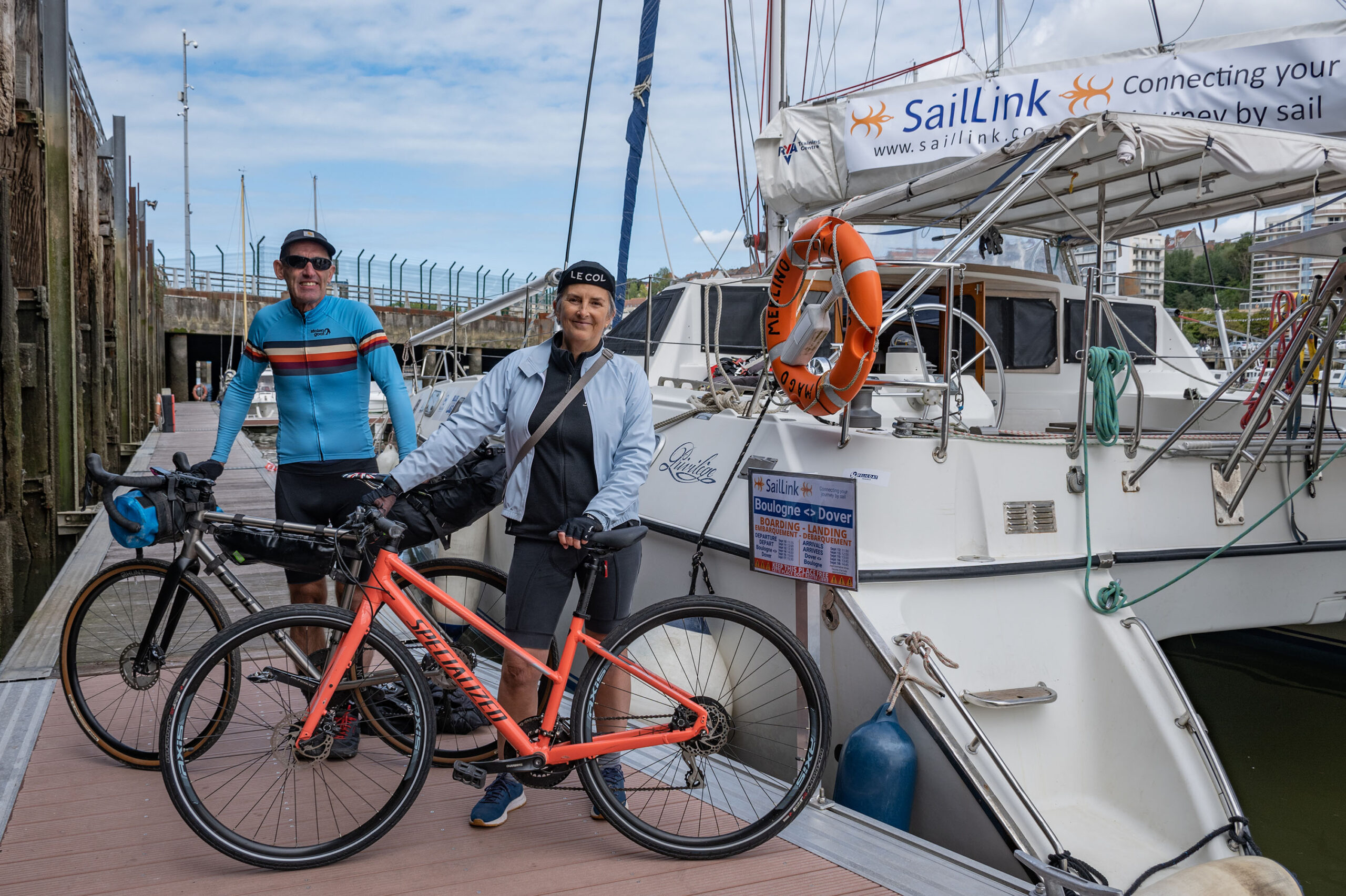
That rider shaped everything about the crossing. Bikes go on whole, and you arrive in the centre of town, right where the cycle routes begin.
How it works at Dover
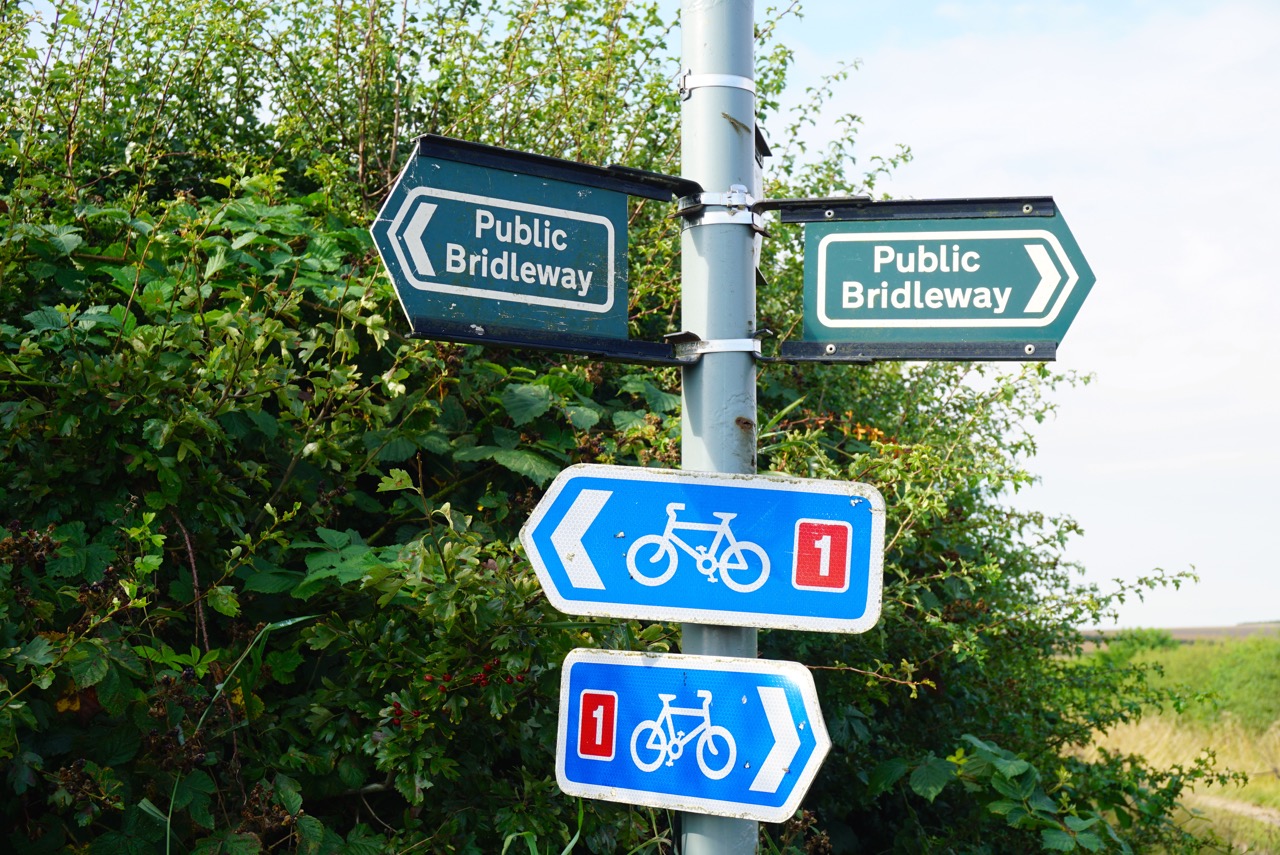
Dover Marina is five minutes by bike from Dover Priory station, where trains from London St Pancras arrive in about an hour. If you are riding down from London, the NCN1 comes in through Canterbury and brings you to the seafront. Be at the pontoon an hour before departure. That hour is for settling in: the passport check, life jackets, the safety briefing and getting your bearings.
Roll up to the pontoon with your bike and hand it over. The crew takes it from there, wheels it on board and inside the catamaran, and straps it in the cabin alongside the others. Your panniers come off so the bike is easier to move into its spot, and they travel with the rest of the passengers' luggage. Every bike is treated like a passenger, because for the person riding it, it often matters just as much.
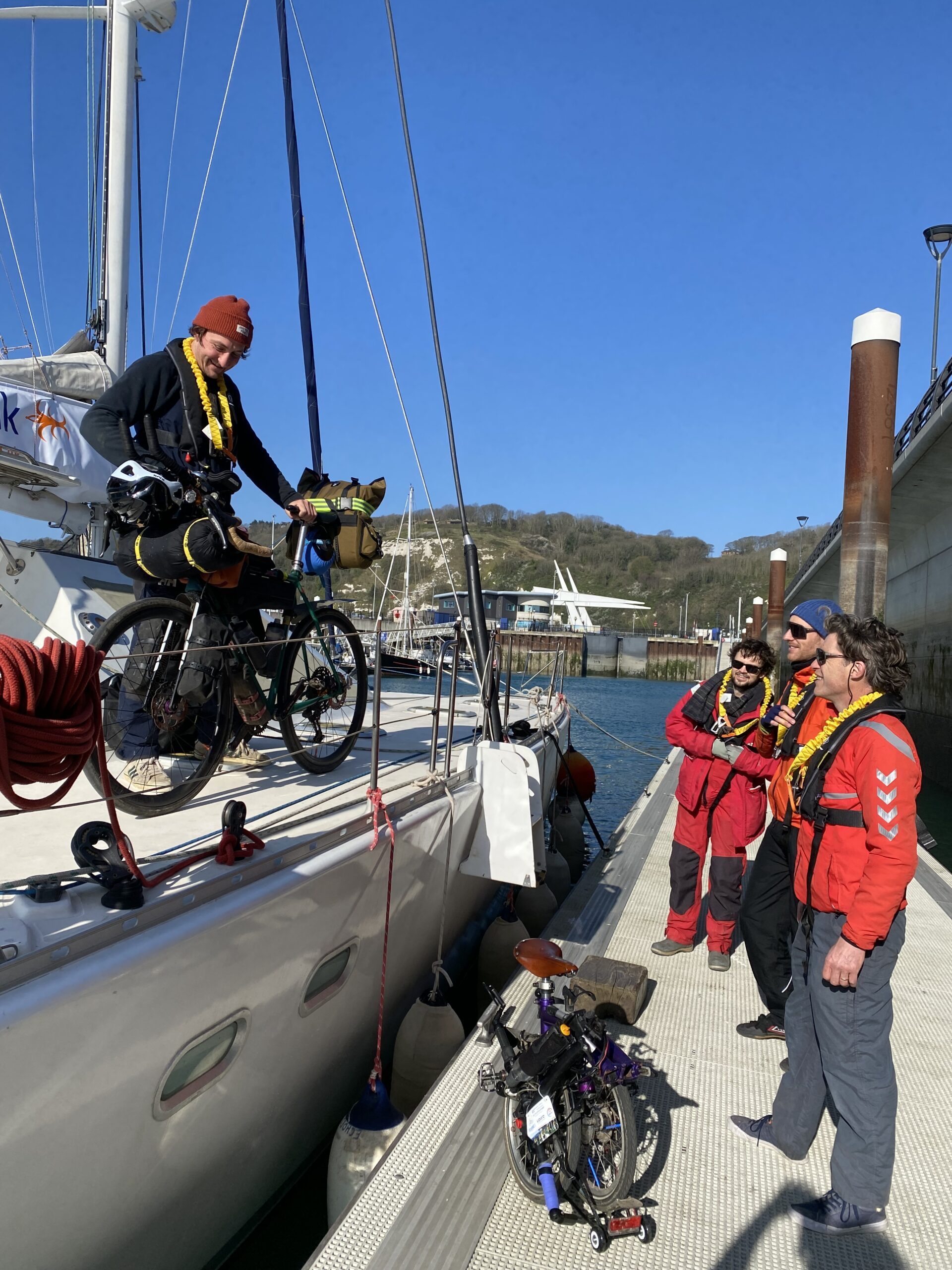
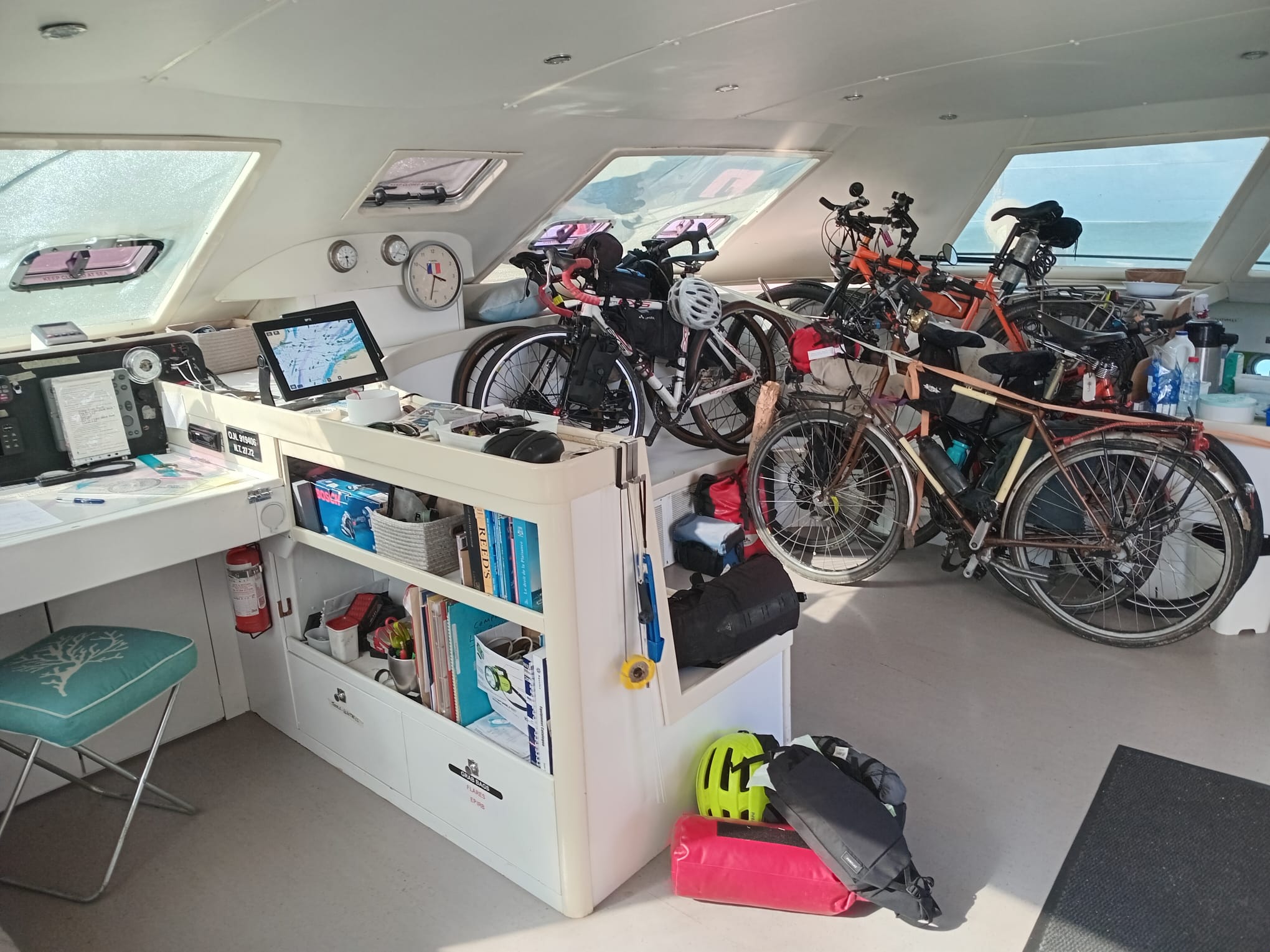
Standard bikes and e-bikes are £10. Larger bikes such as tandems and cargo bikes are £15. Up to 12 bikes travel on each crossing. If you ride something else, write to us before booking and we will tell you whether it fits. Bring everything you can carry with your own two arms; there is room for it.
Time, tide and room for adventure
Our timetable is worked out each winter from the tides between Dover and Boulogne. The departure time is fixed; the arrival time depends on the wind. Most crossings take about four and a half hours. The fastest in 2026 took 2h18, and a day with little wind can stretch to around five and a half. In 2026 we sailed 74.5% of the distance, and the engine helps when the wind drops.
So leave yourself some slack. If you sail in the afternoon, avoid a tight train or ferry connection that evening, as we cannot be responsible for a missed connection. Before an event, arrive the day before rather than on the day. If the weather keeps us in port, you get a seat on the next available crossing, an extra sailing if the timetable allows it, or a voucher or a full refund.
If you have to be on the other side at a precise time, with no margin at all, SailLink is not the right crossing for that trip, and we would rather you knew before booking. Even the big ferries stay in port when a storm comes through. For everyone else, the extra hours are what the trip is about: more time on the water, with England slipping away behind you and France coming up ahead.
Riders who crossed with us
Claire Wyatt rode solo and self-supported from Mongolia back home to the UK, raising money for MAG (Mines Advisory Group). In 2025, after months on the road, she rode the last stretch across the Channel with us, from Boulogne to Dover. You can follow her rides on Instagram at @exploringbybicycle.
Louis went the other way. In 2025 he crossed from Boulogne, rolled off at Dover Marina and followed the NCN1 north, all the way to Kirkwall in Orkney, and later crossed back with us from Dover, with France Télévisions filming the return. In his words: “The crossing was not the start of the trip. It was the trip.” His story, and his practical notes on the route, are on our NCN1 page.
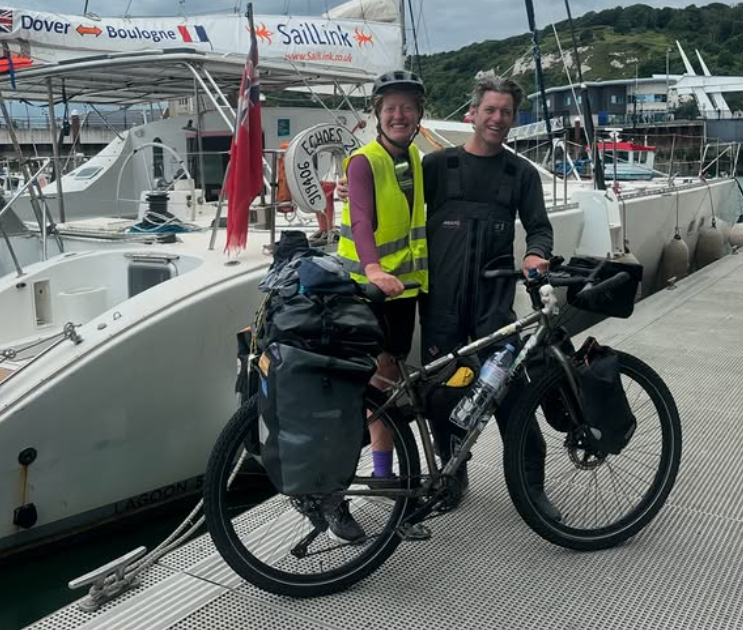
Others came for shorter trips. In August 2026 a family of nine, with children aged 10 to 15 and nine heavily loaded bikes, crossed with us at the start of their holiday. Another rider used the crossing as the first leg of a ride from the UK to Spain.
“The perfect start or finish to a cycle trip. A really easy and laid back way to cross the Channel.” A passenger, May 2026
Where to ride once you land in Boulogne
The passport check at Boulogne happens on the pontoon and takes about ten minutes, because your details are sent to the border police ahead of time. Then the bikes come off, you push them up the pontoon and you are on La Vélomaritime (EuroVelo 4) straight away.
Before going anywhere, have a coffee at Proqua, a few minutes from the marina and part of the Accueil Vélo network for cyclists. If you are carrying on by train, Boulogne-Ville station is five minutes away by bike. Monsieur Georges, right in front of the pontoon, is the easiest place to stay. The walled old town at the top of the hill is worth the visit, though it is a proper climb with a loaded bike, and Wimereux is 20 to 30 minutes up the coast. Then pick a direction.
The Two Capes, back via Calais (2 days)
The Vélomaritime stage from Boulogne to Calais is 51 km with about 330 m of climbing, through Wimereux, Ambleteuse, Cap Gris-Nez, Wissant, Cap Blanc-Nez and Sangatte. From Cap Gris-Nez the English coast is 33 km away, and Cap Blanc-Nez rises 130 m above the bay of Wissant. Sleep in Wimereux or Wissant, then take a ferry home from Calais. One of our 2026 riders did this exact loop the other way round.
The Bay of the Somme, back via Dieppe (4 to 5 days)
Ride south past Le Touquet and Berck to Le Crotoy, 93 km from Boulogne, then round the bay to Saint-Valery-sur-Somme and the Parc du Marquenterre bird reserve, and on through Cayeux and Le Tréport to Dieppe, 178 km in all. DFDS sails from Dieppe to Newhaven in about four hours and takes bikes. With more time, keep following the coast to Étretat and Le Havre, or as far as the D-Day beaches, and sail home to Portsmouth.
To Paris on the Avenue Verte (8 to 10 days)
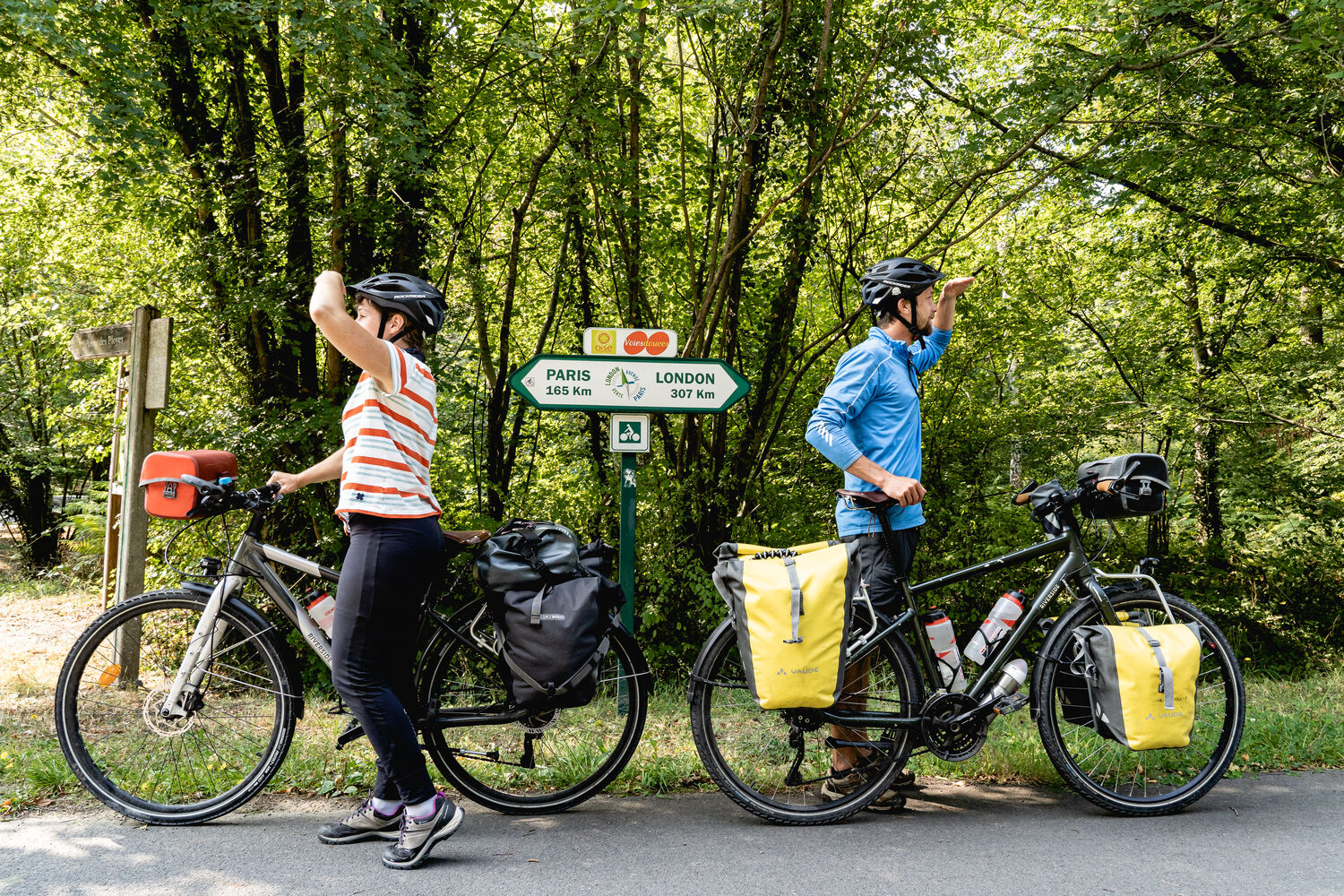
Follow the coast to Dieppe, then the Avenue Verte London-Paris through Normandy, about 260 km from Dieppe to Paris. Our Paris to London route describes it stage by stage, in the other direction. To come home, a TER from Paris Nord to Boulogne takes about two hours forty with a bike reservation, and you sail back with us, your bike still in one piece.
Why it costs what it costs
A seat with us costs more than a foot passenger ticket on a big ferry, and the current fares are on our prices page. There are only 12 seats on each crossing, and we have no subsidies and no economies of scale to spread the cost. SailLink is funded by ordinary people who believe in it, with no bank behind us. For that price you get four or so hours at sea with eleven other passengers and the crew, as part of the crossing rather than a number on a manifest, and a different way of getting from one country to the next.
Every ticket is what keeps SailLink sailing and lets us imagine what comes next. There is nothing without you, and that is what makes the difference in what we are building. We are building it together, and showing the next generation that another way of travelling is possible.
Questions cyclists ask us
Can I take my bike on the ferry from Dover to France?
Yes. P&O and DFDS take bikes from Dover to Calais, and DFDS also sails to Dunkirk, with your bike travelling on the car deck. With SailLink you sail from Dover Marina to Boulogne-sur-Mer, and your bike travels inside the cabin.
Can you cycle through the Channel Tunnel?
Not on your bike. LeShuttle carries cyclists and their bikes in a dedicated minibus between Folkestone and Calais, with two pick-ups a day from Folkestone, at £50 per bike each way.
Do I need to take my bike apart?
No. You hand it over on the pontoon and the crew rolls it inside the catamaran, where it travels strapped in the cabin. Your panniers come off and travel with the passengers' luggage.
How much is a bike?
£10 for a standard bike or an e-bike, £15 for a larger bike such as a tandem or a cargo bike, with up to 12 bikes per crossing. For any other kind of bike, contact us before booking.
Where do I meet the boat in Dover?
At Dover Marina, on the seafront below the castle, five minutes by bike from Dover Priory station. Our Dover page has the details. Be there an hour before departure.
How long does the crossing take?
About four and a half hours. The departure time is fixed and the arrival time depends on the wind, from 2h18 on our fastest day in 2026 to around five and a half hours when the wind is light.
What if the weather stops the crossing?
You get a seat on the next available crossing, an extra sailing if the timetable allows it, or a voucher or a full refund. Some passengers choose to cross by ferry from Calais instead.
When can I book for 2027?
The 2027 timetable opens for booking this winter. Newsletter subscribers hear about it first, 48 hours before everyone else; you can sign up at the bottom of this page.
Come as you are
SailLink is made for you, and it gets better with you. The whole idea is to take the logistics off your shoulders, so that crossing the sea under sail becomes a part of the trip you enjoy fully. Rolling a bike onto a catamaran and riding on as soon as you land feels like the most natural thing in the world, with the wind doing the work and adventure back at the heart of the journey. No pressure, no special kit. Come and ride with us, on the water.
If you have a question before you book, write to us at info@saillink.co.uk.
Dover ↔ Boulogne-sur-Mer
Come ride with us, on the water.
Bikes roll on whole, up to 12 per crossing. 2027 dates open this winter.