
The Via Francigena.
Cross the Channel by sail.
Walk or cycle Canterbury to Rome. The crossing is part of the pilgrimage, not a car ferry to sit through.
Walk or cycle the Via Francigena, and cross the Channel by sail instead of by car ferry.
The Via Francigena runs from Canterbury Cathedral to Rome, across England, France, Switzerland and Italy. The English section crosses Kent from Canterbury to Dover, around 30 km. Then comes the Channel. The official modern route crosses from Dover to Calais, traditionally by car ferry. SailLink offers the alternative: a sailing crossing from Dover to Boulogne, on the Cote d'Opale.
SailLink does not land you at the Calais ferry terminal. It lands you at Boulogne Marina, on the Opal Coast, a short ride up the coast from Wissant, where Sigeric actually landed in 990 and an official stage of the Via Francigena today. From Boulogne you follow the coast north through Cap Gris-Nez to rejoin the route, or cut inland towards Wisques and Arras. It is a small detour that swaps a lorry deck and a terminal for a sailing crossing, closer to the historic pilgrimage than the modern Calais route.
The route was first documented in 990 AD by Sigeric, Archbishop of Canterbury, who recorded 79 stages on his return from Rome. It was declared a Cultural Route of the Council of Europe in 1994. It works in both directions. Southbound: Canterbury to Dover, then SailLink to Boulogne, then south to Rome. Northbound: board at Boulogne, cross to Dover, then north to Canterbury Cathedral. Either way, SailLink carries walkers and cyclists, and the crossing is part of the journey.
Canterbury to Rome, on foot or by bike.
The English section runs from Canterbury south to Dover, around 30 km through the Kent countryside. At Dover Marina, SailLink is the sailing alternative to the Calais car ferry: a crossing to Boulogne on the Opal Coast, a short ride from Wissant where the route runs. No lorries, no car deck. The road to Rome starts properly on the boat.
About the crossingRome to Canterbury. The route works in reverse.
Coming from Italy, Switzerland or France and heading north, follow the Opal Coast to Boulogne and board SailLink. The crossing to Dover Marina takes around 4h30 on average under sail. From Dover, the Via Francigena and NCN1 both lead north to Canterbury Cathedral, the route's English terminus.
Northbound informationSigeric crossed by sail in 990 AD and landed at Wissant. You can do the same.
Sigeric the Serious, Archbishop of Canterbury, travelled to Rome to receive his appointment from the Pope in 990 AD. On his return, he recorded 79 stopping points. That diary became the foundation of the Via Francigena. He crossed the Channel from the Dover coast and landed at Wissant, a village on the Cote d'Opale between Cap Gris-Nez and Cap Blanc-Nez. Wissant is still an official stage of the route today, and it sits a short ride up the coast from Boulogne, where SailLink lands.
The Via Francigena was declared a Cultural Route of the Council of Europe in 1994, joining the Camino de Santiago among Europe's great pilgrimages. Unlike the Camino, it stays far quieter, and its English section is among the least-walked stretches of any major European route. The Kent countryside between Canterbury and Dover is unhurried and largely unchanged.
Sigeric crossed by sail in 990 AD. So can you.
When Sigeric crossed the Channel on his way home from Rome, he did not board a car ferry. He crossed by sail and stepped ashore at Wissant. The water between England and the Opal Coast was not a transit zone to be endured. It was the sea itself, to be crossed. A threshold between two worlds, two languages, two landscapes.
That moment survived for a thousand years in pilgrimage tradition. The crossing of the Channel was always understood as a distinct stage of the journey, a passage with its own meaning. Medieval pilgrims watched England disappear and France appear. They arrived changed, not just relocated.
The car ferry erased all of that. Drive aboard, sit in a plastic seat with the windows closed, drive off at the terminal. The sea becomes invisible. The crossing becomes nothing.
SailLink restores the original experience. Twelve passengers. No vehicles. Open deck. The wind in the rigging. The White Cliffs retreating. The Cote d'Opale growing ahead. Around 4h30 on average, fully present on the water, the way Sigeric crossed. The Channel is not the interruption between two halves of the Via Francigena. It is one of its great moments.
"Sigeric departed Canterbury, crossed the sea at Dover, and came ashore in France at Wissant."
After Sigeric's travel record, 990 AD"I rolled my bike onto a sailing boat in Boulogne and off again under the White Cliffs. That was the best day of the whole trip."
SailLink passenger, 2025Sail, not a car deck. The official route now crosses Dover to Calais by car ferry. SailLink crosses the same sea under sail and lands at Boulogne, a short ride up the Opal Coast from Wissant, where Sigeric came ashore. The water is the same. The difference is how you cross it.
The Channel crossing is not the interruption. It is the highlight.
Every Via Francigena pilgrim and cyclist faces the same sea. Most take the Dover to Calais car ferry. SailLink is the sailing alternative, Dover to Boulogne, landing on the Opal Coast a short ride from Wissant.
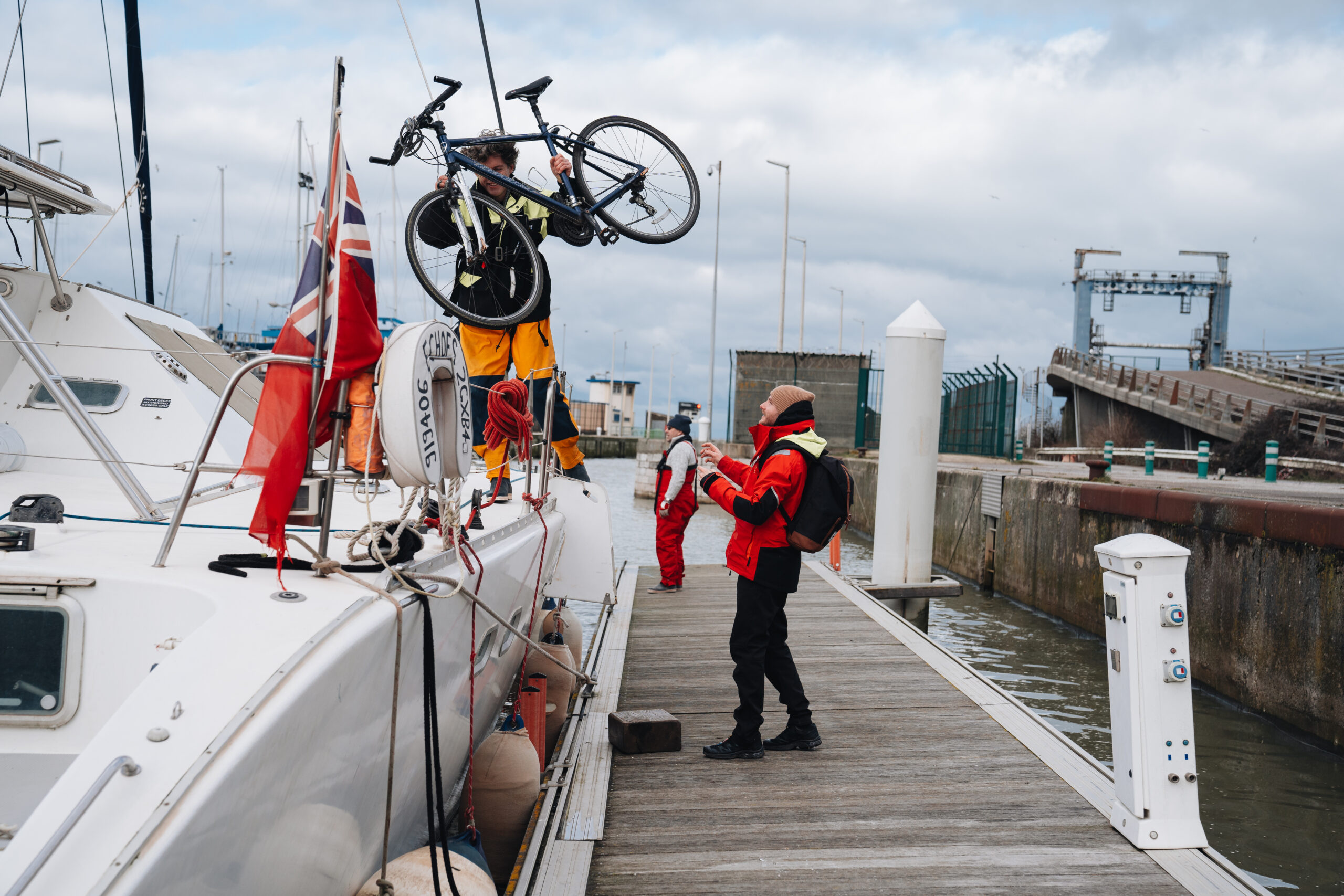
No car ferry terminal. No queues. No lorries. SailLink departs from Dover Marina going south, and from Boulogne Marina going north. Walkers board with their packs. Cyclists roll on with loaded bikes, no dismantling required. 12 passengers. The open Channel. Around 4h30 on average under sail.
Southbound: the White Cliffs of Dover disappear behind you, the French coast grows ahead, and you step off at Boulogne Marina. Follow the Opal Coast north to Wissant to join the historic route, or head inland towards Arras and Reims. Northbound: board at Boulogne, the White Cliffs grow on the horizon, and at Dover Marina the Via Francigena leads north to Canterbury Cathedral, around 30 km away. Sigeric crossed this sea in 990. You do the same, under sail.
Book the crossing ↗Dover Marina ↔ Boulogne Marina
 © Oriane Adventures
Canterbury to Rome, stage by stage.
The Via Francigena crosses four countries, around 2,000 km from Canterbury to Rome. The traditional walking route has around 79 stages at pilgrim pace. Cyclists on EuroVelo 5 follow the same corridor with longer daily stages. The cards below read south, Canterbury to Rome. Travelling north, simply read them in reverse: Rome to Canterbury, Boulogne to Dover, on SailLink.
Canterbury to Dover
~30 km · 1 stage (walking) or half day (cycling)The English section begins at Canterbury Cathedral and follows the Kent countryside south to Dover. Quiet lanes through orchards and villages. The White Cliffs visible as you approach the coast. A gentle start before the sea. NCN1 follows the same corridor for cyclists, making this section well-signed and traffic-light.
NCN1, Dover to Scotland ↗Dover Marina to Boulogne Marina
~35 km · 4 to 5 hrs under sailThe sailing alternative to the Dover to Calais car ferry. The same sea Sigeric crossed in 990 AD. SailLink carries walkers and cyclists. 12 passengers, open water, White Cliffs behind you, the Opal Coast ahead. You land at Boulogne, a short ride from Wissant where the historic route runs.
Book the crossing ↗Boulogne to Wissant, joining the route
~20 km · via Cap Gris-NezFrom Boulogne Marina, follow the coast north along La Vélomaritime and the GR coastal path, over the headland at Cap Gris-Nez, to Wissant, where Sigeric landed and where the official Via Francigena runs. From there the route turns inland and south. Walkers and cyclists can also cut inland directly towards Wisques and Arras.
La Vélomaritime (EV4) ↗Calais and Wissant to Reims, Langres, Besancon
~785 km · 3 to 4 weeks (walking)The official French section starts at Calais (Notre-Dame church) and runs through Wissant, Arras, Laon, Reims with its coronation cathedral, Chalons-en-Champagne, Langres and Besancon, before crossing into Switzerland near Pontarlier. Quiet roads, farmland, champagne country.
Pontarlier to the Great St Bernard Pass
~215 km · 2 weeks (walking)The Swiss section crosses the Jura and climbs to the Great St Bernard Pass at 2,469 m, one of the most iconic moments of the whole route. The hospice at the pass has welcomed pilgrims for over a thousand years. Cyclists use the same road with significantly more gradient.
Aosta to Rome, via Tuscany
~1,000 km · 4 to 6 weeks (walking)The Italian section descends from the Alps into the Aosta Valley, crosses the Po Plain through Vercelli and Pavia, climbs the Apennines at the Cisa Pass, and enters Tuscany. Lucca, Siena, San Gimignano. The final approach follows the ancient road south through Lazio. St Peter's Square is the traditional finish.
The only Via Francigena track built for a sailing crossing.
Every other Via Francigena GPX sends you to the Dover to Calais car ferry. This one crosses by sail to Boulogne, then climbs the Opal Coast to rejoin the historic route at Wissant, where Sigeric actually landed in 990. It is closer to the medieval pilgrimage than the modern Calais crossing, and you will not find it anywhere else.
We built it honestly. The two land sections use real surveyed paths (the RideWithGPS Via Francigena and EuroVelo 4 La Vélomaritime). The Channel crossing sits in its own track, clearly marked boat only, so no navigation app ever routes you onto the water on foot. Drop it into Komoot, Garmin, Wahoo or any GPX app.
Canterbury to Rome, by sail
SailLink operates April to mid-September. Conditions decide every crossing, so book your date first and plan the route around it.
Coming from Rome, heading to Canterbury.
The Via Francigena is walked and cycled in both directions. Coming from Italy, Switzerland or France and heading north, the route reaches the coast around Wissant and Calais. From there, follow the Opal Coast south to Boulogne and board SailLink. The sailing crossing from Boulogne Marina to Dover Marina takes around 4h30 on average.
From Dover Marina, the Via Francigena leads north to Canterbury Cathedral, around 30 km through the Kent countryside. NCN1 follows the same corridor for cyclists, well-signed and largely traffic-free. Whether you arrive as a pilgrim completing a journey or a cyclist looking for the next route north, Dover is where the road from Rome reaches Britain.
From Dover, NCN1 continues north to Scotland for those wanting to extend the journey. Edinburgh, Northumberland, the Highlands. The Via Francigena connects here to the full length of Britain.
NCN1, Dover to Scotland ↗From Wissant and Calais, follow the coast south to Boulogne. La Vélomaritime and the GR coastal path run along the Opal Coast over Cap Gris-Nez. SailLink departs from Boulogne Marina. Walkers board with their packs. Cyclists roll aboard. Around 4h30 on average later, Dover Marina.
Hôtel Monsieur Georges is 3 minutes from SailLink's berth. The medieval Old Town is 20 minutes on foot. A good last night on the continent before crossing to Britain.
The Via Francigena from Dover to Canterbury is around 30 km on signed paths. Cyclists follow NCN1, well-marked and mostly traffic-free. Canterbury Cathedral is the finish. Or the start, if you ride on along NCN1 north.
12 passengers per crossing, in either direction. The boat fills quickly in the walking and cycling season (May to September).
Book Boulogne to Dover ↗Practical information
Book SailLink before you book anything else
SailLink carries 12 passengers per crossing and fills fast, particularly in June and September. Book your crossing date first, then plan the route around it. Walkers and cyclists both welcome. No vehicle needed for walkers.
The Calais ferry, and the sailing alternative
The official route crosses Dover to Calais, traditionally on the P&O or DFDS car ferry, foot passengers and cyclists accepted. SailLink is the alternative under sail, landing at Boulogne on the Opal Coast, a short ride up the coast from Wissant. It swaps a lorry deck and a terminal for an open crossing.
Getting from Canterbury to Dover Marina
The Via Francigena from Canterbury to Dover is around 30 km on signed footpaths through the Kent countryside. Allow a full day at comfortable pace. Cyclists follow NCN1, well-signed and mostly traffic-free. Dover Marina is 10 minutes by foot or bike from Dover Priory station.
The pilgrim passport
Walkers can carry a Credenziale, the pilgrim passport stamped along the way. Collect it from Canterbury Cathedral before departure. The official French stamp point is the Notre-Dame church in Calais, a short way up the coast from where SailLink lands.
Best time of year
SailLink operates April to mid-September. For the Via Francigena, May, June and September offer the most reliable weather across England, France and the Alps. July and August are hot in Italy. Spring crossings are quieter and the Kent countryside is at its most beautiful.
Where the route continues after the crossing.
Boulogne-sur-Mer is your landing point on the Opal Coast, and the gateway back onto the Via Francigena via the coast or inland. You are also at the intersection of several major European routes.
Honest note: SailLink lands at Boulogne, not on the official route
We will be straight with you. The official modern Via Francigena crosses Dover to Calais, and the French section starts at Calais. SailLink lands at Boulogne, a few kilometres south on the Opal Coast. To rejoin the route you follow the coast north to Wissant (around 20 km, over Cap Gris-Nez) or cut inland towards Wisques and Arras. It is a short detour, and Wissant is where Sigeric actually came ashore in 990, so in a sense it is truer to the original than the modern Calais crossing. But it is a detour, and you should plan for it.
The English section between Canterbury and Dover, around 30 km, is a mix of signed footpaths, lanes and quiet roads. Walkers will find it well-marked. Cyclists will want a touring or gravel bike rather than a road bike. The Via Francigena is quieter and less organised than the Camino, and infrastructure varies by country. Come prepared, and the route rewards you generously.
"I left Canterbury Cathedral in the rain and arrived in Rome in the sun. Somewhere in between, I spent an afternoon on a sailing boat crossing the Channel. That crossing was the moment I knew the journey was real."
Everything you need to know about the Via Francigena crossing.
How do you cross the Channel on the Via Francigena? +
The official modern route crosses from Dover to Calais, traditionally by car ferry, with the French section starting at Calais. SailLink offers the sailing alternative: a catamaran from Dover Marina to Boulogne Marina, on the Opal Coast, landing a short ride up the coast from Wissant where Sigeric actually landed in 990. The crossing takes 4 to 5 hours, around 4h30 on average, under sail. No car deck, no lorries, no terminal queues. Walkers and cyclists, both directions. SailLink operates April to mid-September.
Is SailLink on the official Via Francigena route? +
No, and we say so plainly. The official route crosses Dover to Calais. SailLink sails to Boulogne instead, a few kilometres south on the Opal Coast. From Boulogne you follow the coast north through Cap Gris-Nez to Wissant, where Sigeric landed in 990 and where the official route runs, then continue south. It is a short detour, around 20 km, that swaps a car ferry terminal for a sailing crossing and a coastal ride.
Where did Sigeric land when he crossed the Channel? +
Sigeric crossed the Channel in 990 AD on his return from Rome and landed at Wissant, a village on the Cote d'Opale between Cap Gris-Nez and Cap Blanc-Nez. Wissant remains an official stage of the Via Francigena today, on the Calais to Wissant section. It sits a short ride up the coast from Boulogne, where SailLink lands.
Where does the Via Francigena start in England? +
The Via Francigena starts at Canterbury Cathedral in Kent. The English section runs south from Canterbury to Dover, around 30 km through the Kent countryside on signed paths and quiet lanes. Dover is the Channel crossing point. SailLink departs from Dover Marina, a 10 minute walk or ride from Dover Priory station.
Can you cycle the Via Francigena? +
Yes. EuroVelo 5, officially named the Via Romea Francigena, follows the historic pilgrimage corridor from Canterbury to Rome and on towards southern Italy, adapted for cyclists with longer daily stages. A gravel or sturdy touring bike is recommended, particularly for the Alpine crossings. SailLink carries loaded touring bikes across the Channel without any dismantling required.
How long does the Via Francigena take to walk? +
Walking the full Via Francigena from Canterbury to Rome, around 2,000 km, takes approximately 70 to 90 days at a comfortable pilgrim pace. Many people complete it in sections over several years. The English section (Canterbury to Dover) takes around one day. The Channel crossing on SailLink takes around 4h30 on average. The French section to the Swiss border is roughly 3 to 4 weeks, and Italy adds a further 4 to 6 weeks.
What is the pilgrim passport for the Via Francigena? +
The Credenziale is the pilgrim passport for the Via Francigena, stamped at churches, hostels and landmarks along the route. It qualifies you for pilgrim accommodation and the Testimonium certificate on arrival in Rome. You can collect it from Canterbury Cathedral before departure. The official French stamp point is the Notre-Dame church in Calais, a short way up the coast from where SailLink lands.